Monday, February 18, 2019

Emails show how fake university set up by ICE lured foreign students Entrapment.
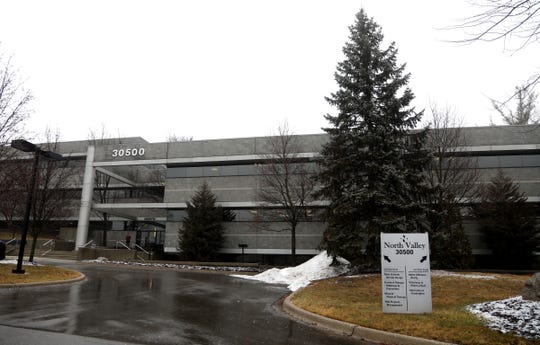
The
building that was used as the fake Farmington University campus by the
federal government seen on Thursday, February 7, 2019, in Farmington
Hills, Michigan. (Photo11: Eric Seals, Detroit Free Press)
DETRIOT — In the summer of 2017, a foreign student in Michigan received an email from an official at the University of Farmington.
"It was a pleasure speaking with you," university official Ali Milani wrote to the student from India. "Thank you for your recent interest in The University of Farmington, a nationally accredited business and STEM (science, technology, engineering, and mathematics) institution. Here at the University of Farmington we have created an innovative learning environment that combines traditional instruction with fulltime professional experiences. We offer flexible class schedules and a focus on students who do not want to interrupt their careers."
At the bottom of the email, it described the university as: "A nationally accredited institution authorized to enroll international students by the U.S. Department of Homeland Security."
The email and others like it were obtained by the Detriot Free Press, revealing how the university portrayed itself to potential foreign students. The email exchanges with Ali Milani — who is described in a LinkedIn profile as the president of the University of Farmington — show how the school in Farmington Hills may have lured students to enroll in a fake university set up by The Department of Homeland Security.
Jan. 30: Feds set up fake university in Michigan to nab undocumented immigrants
A federal indictment unsealed Jan. 30 said that the university was produced by federal agents with an investigative division of U.S. Immigration and Customs Enforcement (ICE), which is part of DHS. Federal agents posed as university officials such as "Ali Milani" to trick the students, say attorneys.
Federal prosecutors allege that more than 600 students enrolled at the university knew it was improper, but the emails and attorneys tell a different story.
In addition to the emails, federal undercover agents took other steps to manipulate the foreign students, according to public records and attorneys:
- Undercover investigators with the Department of Homeland Security registered the University of Farmington with the state of Michigan as a university using a fake name.
- At the request of DHS, a national accreditation agency listed the University of Farmington as being accredited in order to help deceive prospective students.
- The university was also placed by federal investigators on the website of ICE as an university approved by them under a government program for foreign students known as SEVIS (Student and Exchange Visitor Program).
Out of the 600+ students who were enrolled, 146 have been arrested and detained by ICE on civil immigration charges. All are from India except for Najlaa Karim Musarsa, 29, of Dearborn Heights, who is Palestinian. She was released last week and went back to the West Bank.
In addition, prosecutors have charged eight people for being recruiters of the students, most of whom studied in engineering and technology fields. Five of them were arraigned in U.S. district court in Detroit last week and pled not guilty.
Feb. 3: India urges U.S. to release foreign students detained by ICE in fake university sting
"It really shows a contempt for immigrants, Zahr said of the detaining of Musarsa and other students.
"She's not a danger to society. She's not trying to defraud. To treat her and others as hardcore criminals" is concerning, Zahr said. "They want to create fear, so non-white people, brown people don't think of coming to America anymore."
Concern about the detainees
There are reports in Indian-American and Indian media outlets such as The American Bazaar saying that some of the students were being held in poor conditions and not getting vegetarian food in accordance with their religious and cultural beliefs. Some students were already removed, and are now stuck in India with debt, said a Times of India report. The report said some come from poor farming backgrounds and had to take out loans to support their studies in the U.S.The university charged $11,000 a year for graduate students.On Thursday, four U.S. House Reps, including U.S. House Rep. Brenda Lawrence (D-Southfield) released a letter they sent to DHS and ICE, expressing "concerns surrounding the recent undercover operation conducted by U.S. Immigration and Customs Enforcement’s (ICE) Homeland Security Investigations (HSI)." The Indian government has also expressed its concern in a letter from its Ministry of External Affairs.
The letter from the Congressmen said that Indian-Americans "have expressed concerns regarding the treatment of these detained foreign nationals. We urge DHS and ICE to ensure the detained students are treated properly and afforded all rights provided to them under the law, including access to an attorney and release on bond, if they are eligible."
In a statement, ICE spokesman Khaalid Walls said: "ICE remains committed to ensuring its facilities adhere to ICE’s detention standards which provide several levels of oversight in order to ensure that residents in ICE custody reside in safe, secure and humane environments."
Many of the students who were enrolled at the University of Farmington had previously received masters degrees from a different university, like the student that Milani had written to. The name of the student in the email is not being identified at the request of an attorney.
They were generally admitted to the U.S. on non-immigrant F-1 student visas and were allowed to work while enrolled at a university on programs known as OPT (Optional Practical Training) or CPT (Curricular Practical Training), said attorneys in contact with the students. Some were trying to get H1-B visas to stay for a longer time in America, but there is a cap on those, and so they sought other ways to remain working in the U.S.
Attorney: Fake university sting by ICE was entrapment
After their masters degree programs ended, the students would be ineligible to remain working in the U.S. and so some sought to get a second masters degree at the University of Farmington. In other cases, their previous universities had problems with accreditation, which made them ineligible to work, and so they tried to transfer, said Atlanta-based immigration attorney Ravi Mannam.
Emails from the university to student
In the June 2017 email sent by Milani, the president of the fake university, Milani wrote to the Indian student: "In many instances, your prior Masters Degree’s (MA) credits, combined with CPT, can be applied to a second MA in lieu of a traditional course load."Milani wrote to the student about its tuition and accreditation: "The University of Farmington operates on a quarterly academic calendar, each term is generally ten weeks, excluding exams, and the admissions process is on a rolling basis. Terms start every three months, beginning in September, December, March, and June. Sessions begin every month. Graduate programs tuition is $2500 per quarter. Depending on fees, average cost is $1,000 per month."
"We are accredited by the Accrediting Commission of Career Schools and Colleges (www.accsc.org) and licensed by the Michigan Department of Licensing and Regulatory Affairs as a private postsecondary college," he wrote.
The executive director of the Accrediting Commission of Career Schools and Colleges (ACCSC), Michale McComis, told the Free Press that his group worked with federal agents on the sting operation.
"Upon request by the US Department of Homeland Security ACCSC assisted in the operation by listing the school as being accredited by ACCSC," McComis said.
The same group had accredited a fake University of Northern New Jersey at the request of DHS. In that case, though, ICE didn't make mass arrests of students like they have of the Farmington students.
More: 21 Savage says he was 'definitely targeted' by ICE in first interview since arrest
Records filed with the state Department of Licensing and Regulatory Affairs (LARA) show that the University of Farmington was incorporated in January 2016. Prosecutors have said their undercover operation started in 2015.
Ali Milani is listed in the state records as the university's resident agent. A spokesman for LARA, Jason Moon, refused to comment on the fake university and whether the state had cooperated with federal investigators on their sting investigation.
In the June 2017 email to the student, Milani sent the student a 2-page application form that asks applicants to send a $100 application fee.
"If you are interested in having your tomorrow start today, please complete the attached application and submit a copy of your passport and current visa," Milani wrote.
His email ended with: "Good luck in all your endeavors."
The student filled out the application and emailed Milani back in a couple of hours. The next day, June 29, Milani said the student was admitted, writing that he was attaching the "admission letter along with the international student checklist and SEVIS transfer form."
SEVIS is the Student and Exchange Visitor Program that is run by ICE, which oversees the program for students on F-1 visas, like the ones at the University of Farmington.
More: Deported after 30 years in US, father still stuck in Mexico one year later, without wife and kids
The next week, the student asked to defer his admission until December. In October, the student then asked Milani to transfer his SEVIS "today" because his OPT expires.
"I have been trying to reach out to you since morning, but couldn't get hold of it. Please let me know ASAP, its URGENT," the student wrote.
After enrolling at the university, some of the students discovered there were no classes, said attorneys. But the university kept on telling the students that classes would soon be held.
Students 'taken advantage of'
"I was told by the students, that the university reassured them that classes would be held and everything would be fine and that they are following the immigration laws," said Prashanthi Reddy, an attorney in New York City. "The students payed them the tuition fees and were trapped once they realized that classes were not being held, as some didn't have the money to transfer and pay tuition at another university."Reddy said "some did transfer out, some said they called and emailed the university and asked for SEVIS to be transferred but did not get a response, some others said they were reassured by the fact that the University was accredited and listed on the ICE website."
Adding to the confusion was a website that led viewers to think it was a legitimate place, with photos of students in classrooms and claims that students could work while enrolled.
More: ICE tried to deport a U.S.-born Marine, and his mom wants to know why
"The University of Farmington is a nationally accredited business and STEM institution located in Metro Detroit," read the university website created by DHS that was taken down the day after the indictments were unsealed. "Our innovative curriculum combines traditional instruction and distance learning with fulltime professional experiences. We offer flexible class schedules and a focus on students who do not want to interrupt their careers."
The university even had a fake backstory, saying that it "traces its lineage back to the early 1950s, when returning soldiers from the Second World War were seeking a quality and marketable education. At the time, Detroit was the center of innovation and manufacturing. ... Please explore our academic offerings to see if University of Farmington is the right place to achieve your success."
"It was a very well put together website," said Russell Abrutyn, an immigration attorney in Berkley who is contact with some of the students. "It looked like a real school."
"I think a lot of these students ... were essentially taken advantage of or taken in by what appeared to be a legitimate school."
Follow Niraj Warikoo on Twitter @nwarikoo
TRUMP DECLARES NATIONAL EMERGENCY! DO YOU KNOW WHAT THIS MEANS?!
VERY IMPORTANT UPDATE! MORE PREPARATION! On the morning of Fri. Feb. 15th, 2019, President Donald Trump announced a “national emergency” in order to build the border wall. Trump claims that this decision was done in order to “protect the country” from the flow of drugs, criminals, and illegal immigrants coming across the border from Mexico — A supposed “profound threat to national security.” This national emergency declaration will thus avert the prolonged 35-day record government shutdown as of Dec-Jan. 2019. According to White House officials, this declaration will enable Trump to “$3.6 billion budgeted for military construction projects to the border wall.” But What Is The REAL Reason For This? What Is This National Emergency REALLY Foreshadowing? On top of all that, Trump’s declaration of a “national emergency” over a border wall is very reminiscent to REX 84, also known as “Readiness Exercise 1984” — Which was was a classified scenario and drill developed by the United States federal government to detain large numbers of United States citizens deemed to be "national security threats", in the event that the President declared a "State of National Emergency.” But it was also originally established on the reasoning that if a “mass exodus” of illegal aliens crossed the Mexican/US border, they would be quickly rounded up and detained in detention centers by FEMA. Interestingly enough, on the same exact day is the official release of the video game “METRO EXODUS.” Per “Black History Month” that is observed every Feb. of the year, for the 2019 Special Edition, USA Today decided to entitle their theme: “EXODUS: How Black Migrations Changed Our Nation” — Along with the cover also saying: “400 Years Ago: The African Arrival In America; Black Education Opportunities; Soul Food: USA’S 1st Fusion Cuisine” With all of these “EXODUS” references coinciding with Trump, Army drills, national emergencies, the recent “Trump emperor float” spotted at the Italian Viareggio Carnevale 2019, near-record cold polar vortex, allusions to power outages, record government shutdown, and the Pope’s historic visit to the United Arab Emirates (UAE) — what is all of this leading up to? Could they be preparing for martial law and a simulated police state?! THE TRUTH REVEALED!!! NOTE THE WARNING SIGNS AHEAD OF TIME!!! NOW IS THE TIME TO REPENT! PLEASE SEEK YAHUAH AND HIS TRUE SON YAHUSHA — SO THAT THE TRUTH WILL MAKE YOU FREE!!! ALSO SEE — The Obama Portraits: https://youtu.be/kqBoMmI5_-I ALSO SEE — Super Bowl LIII, Pope: https://youtu.be/6x5WVxq64sE ALSO SEE — More On Power Outage: https://youtu.be/sQ1VG8WWfWk ALSO SEE — More On Army FM 3.39-40: https://youtu.be/qq1mlMzWuZo ALSO SEE — Project Blue Beam: https://youtu.be/BjqaMJrfq5U ALSO SEE — Ronald Reagan, Alien Deception: https://youtu.be/zXFIg4zCUEk ALSO SEE — 400 YEARS, PROPHETIC 2019!!! https://youtu.be/VAmRIQeLu9U ALSO SEE — THE REAL JERUSALEM REVEALED! https://youtu.be/nL8ugkTj1yw ALSO SEE — THE REAL JERUSALEM TEMPLE LOCATION FOUND!! https://youtu.be/sOSBNG74eOw LEARN MORE! Trump National Emergency NBC: https://www.nbcnews.com/politics/poli... 10 USC S. 2808 (Cornell): https://www.law.cornell.edu/uscode/te... National Emergencies Act: https://www.congress.gov/bill/94th-co... National Emergency Centers Establishment Act: https://www.congress.gov/bill/111th-c... Executive Orders: http://www.sweetliberty.org/issues/eo... Executive Order 12656: https://www.archives.gov/federal-regi... REX 84, Operation Garden Plot Wiki: https://en.wikipedia.org/wiki/Rex_84 GR: https://www.globalresearch.ca/rex-84-... Trump Float Italy: http://time.com/5526224/trump-float-i... “The X Files” Season 10 Premiere: https://www.imdb.com/title/tt4549938/... Pope Historic Visit UAE: https://www.thenational.ae/uae/the-po... Metro Exodus, EXODUS! Wiki: https://en.wikipedia.org/wiki/Metro_E... USA Today Cover: http://onlinestore.usatoday.com/black... USA Today Article (“The Promised Land”): https://www.usatoday.com/story/news/i... USA Today Article (THE REAL PROMISED LAND!): https://www.usatoday.com/story/news/w...
Friday, February 15, 2019
The Assassination of Hugo Chavez; By Greg Palast
The real story on Hugo Chavez you won't get on CNN. Palast meets with Chavez, his kidnappers and would-be assassins.
The real story on oil, power, death and Reverend Pat Robertson. Based on Palast's reports for BBC, Harper's and Rolling Stone. http://www.gregpalast.com/
Watch Cops Ruin a Family's Life in 4 Minutes on Camera!
WARNING and CONTEXT: This video has graphic language and violence...and is to be taken as an educational and informative analysis on what has been happening around the country in regard to police encounters. This is a PUBLIC SERVICE-oriented video.
On July 27, 2017, Johnny Wheatcroft was a passenger in a silver Ford Taurus when a pair of Glendale police officers pulled in front of the car in a Motel 6 parking lot. The stop was for an alleged turn signal violation. Minutes later, Wheatcroft was handcuffed, lying face down on the hot asphalt on a 108-degree day. He'd already been tased 10 times, with one officer kneeling on his back as another, Officer Matt Schneider, kicked him in the groin and pulled down his athletic shorts to tase him a final time in his testicles, according to records and body camera footage first obtained by ABC15. Raw video: https://www.youtube.com/watch?v=Jckr9...
Petrodollar Warfare: The Common Thread Linking Venezuela and Iran
WASHINGTON — Last Wednesday, U.S. Secretary of State Mike Pompeo gave a disturbing interview to Fox Business Network in which he divulged his plans to form a NATO-type alliance against Iran. The U.S. has long accused Iran of supporting terrorism, accusations that have ramped up under the Trump administration. Pompeo said, without a hint of irony, that Iran’s government was leading the country into wars in Syria, Yemen, Iraq, and Lebanon, against the will of the Iranian people. Furthermore, the absurd accusation that Hezbollah is in Venezuela seemed a crude attempt to link the two countries in order to delegitimize both of their governments at the same time. The announcement foreshadows the potential for an abrupt and extreme escalation of U.S. attacks on Iran, similar to the recent escalation of U.S.-Venezuela relations.
Washington’s playbook for regime change has become more and more obvious as it is used more frequently. In the cases of countries with powerful militaries like Venezuela, Iran, North Korea, or China, outright invasion is unfeasible, as disapproving public opinion would drag morale down. Demonizing the target via some pretext to isolate it from the international community has been the preferred model to deal with larger threats.
The U.S. imposes financial sanctions under the guise of “targeting regime figureheads and their inner circle of cronies,” and sweeping banking restrictions that cut a country’s entire economy off from investment and foreign reserves. As the country deteriorates under the weight of these sanctions, Washington points to the chaos it has created and says — again, without a hint of irony — “This is clearly a consequence of a neglectful and incompetent regime that must be overthrown.” The time period between the present and that unknown future date when the U.S. escalates is a crucial time for Iran to prepare itself for the worst case scenario.
The U.S. is able to dictate these econo-warfare policies through its disproportionate control of the world financial system. Iran has been sounding warnings about this strategy for some time and has been a vocal advocate of creating a new global financial system that will bypass U.S. control of the existing global financial system. Iran, though, is not the only country interested in such an arrangement. Russia, China, and Venezuela have all found themselves facing arbitrary economic penalties levied by the U.S. and have also taken steps to wean the world off the dollar and use alternative currencies to conduct business, a global trend that could seriously impact U.S. dominance over the world economy. But in order to understand where “King Dollar” is going, we have to understand where it came from.
The Birth of the Petrodollar
One of the first lessons we learn in Econ 101 is that money has value only because we believe it does. In a practical sense, this means the currencies that are most used or most needed to purchase things are the most valuable. A reserve currency is simply a widely accepted currency. Most countries have both a domestic currency for domestic use and foreign reserves, which are designated for foreign trade and other international activities. A few powerful countries issue reserve currencies, or widely recognized and accepted currencies, and have an advantage in international trade because they can simply print world reserve currencies instead of exchanging currencies or selling goods to acquire that currency.
Today, the U.S. dollar holds the status of world reserve currency because it is the most recognizable and widely used unit of currency in the world. You can take a dollar to any random country, any market on the side of the street, and show them a greenback and chances are they will accept that funny little paper as payment. If I decide to start a seashell-based currency today, chances are I won’t be able to buy anything with my seashells.
There is nothing inherently more special about our green piece of paper than someone else’s blue paper, red paper, or yellow paper; the dollar is special only because it represents a very special country, the United States of America, a superpower the likes of which the world has never seen. Where American power goes, its money always follows to become the region’s unit of economic measurement. The currency that goods are priced in is very important because if, for example, oil is priced in dollars, you need dollars to buy oil. This creates demand for dollars and not yen or rubles, giving a tremendous advantage to the country that prints dollars at no cost.
Before the international dollar standard, there were other world reserve currencies. The worldwide dominance of the Dutch East India Company made the Dutch guilder the world reserve currency in the 17th and 18th centuries. With the ascendance of the British Empire came the ascendance of the Pound Sterling to world reserve currency status.
As the world’s leading exporter of manufactured goods and services, British banks had accumulated a large amount of gold deposits. The Bank of England issued sterling certificates, paper that could be exchanged for gold, making the sterling as “good as gold.” This gave foreigners confidence that the paper sterling was not just paper but backed up by something of tangible value. British investors chasing higher returns expanded the reach of sterling further by making sterling-denominated long-term investments (read loans) around the world. At its height, over 60 percent of world trade was denominated in pound sterling.
But, as had all empires before it, the British Empire over-expanded and collapsed, unable to militarily control the land it claimed as its own. However, as the British cities were reduced to rubble in the Second World War, the United States, untouched throughout the war, got rich selling weapons to the other allied powers. Through exporting weapons, ammunition, equipment, and food, America’s war economy accumulated 75 percent of the world’s gold, making it the undisputed economic power of the capitalist world. No other country had enough gold to back its currency’s value.
Recognizing this, the leaders of the European capitalist powers agreed to make the dollar the new world reserve currency by pegging the dollar to gold at a fixed exchange rate of 35 dollars per ounce of gold. Other countries could exchange their currency for dollars instead of gold, the logic being the dollar was as good as gold. The International Monetary Fund was set up to ensure the U.S. maintained this exchange rate and the IMF acted as a lender of last resort if a country’s currency value fell too low compared to the dollar.
This was not just a convenient arrangement but a necessary one, as the European capitalist empires had fallen and needed to pass their power on to an heir. It was the recognition that now the United States was the only country powerful enough to organize and enforce worldwide markets. In addition, the use of nuclear weapons to wipe Hiroshima, Nagasaki, and 200,000 Japanese civilians off the map sent a message to the world that the United States was more militarily advanced and ruthless than any other country on the planet. A new global empire was born.
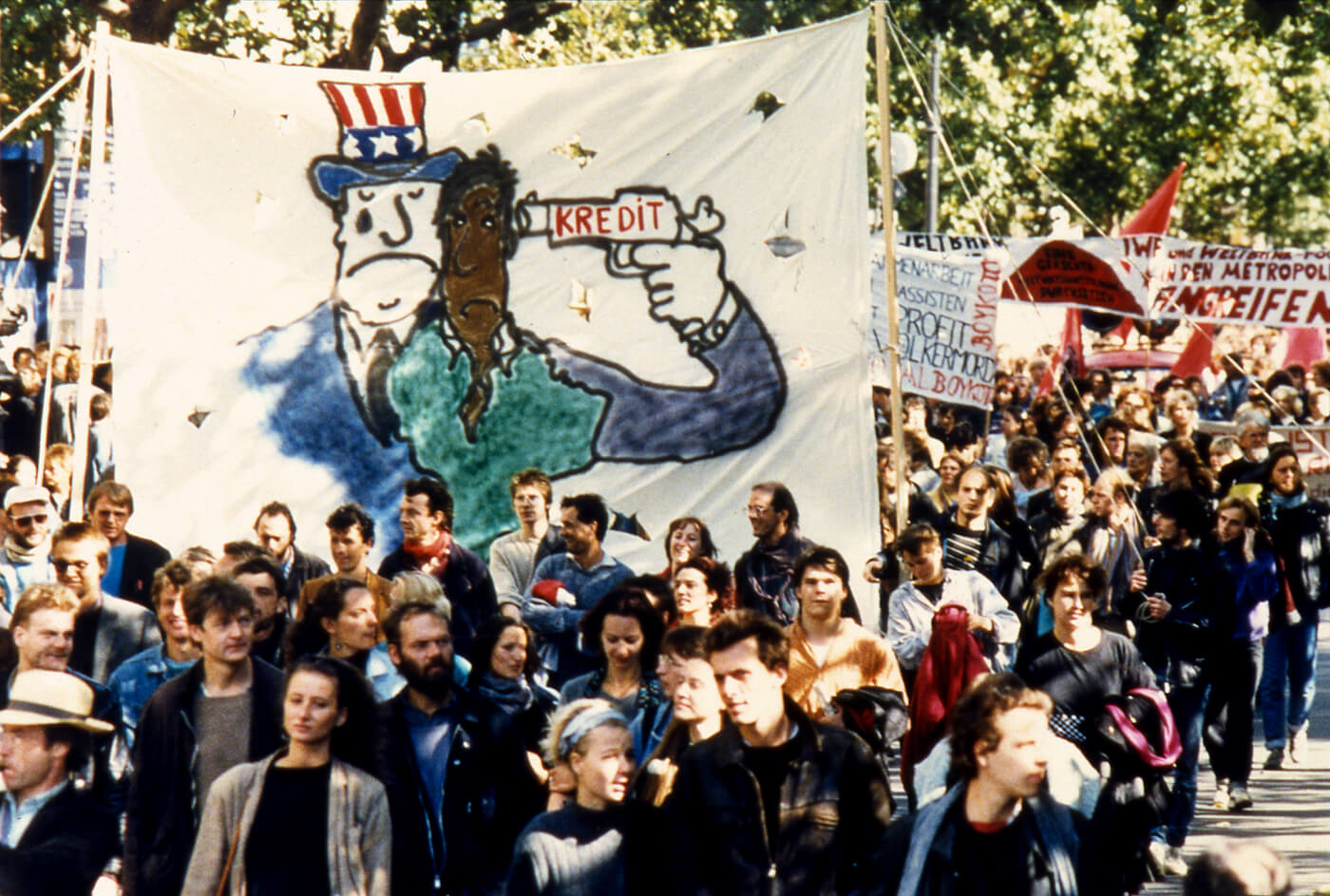
Some ten thousand people take part in a demonstration against the IMF and the World Bank meeting, Sept. 27, 1988, in West Berlin, West Germany. Jockel Finck | AP
The United States immediately embarked on a series of invasions, mass killings, and covert regime-change operations in places like Korea, Guatemala, Iran, and Vietnam, to expand its spheres of influence. In order to fund these excursions, the United States began printing dollars, a privilege enjoyed solely by the United States. Since a dollar represented 1/35th of an ounce of gold, the United States was essentially printing claim checks for gold, gold that the United States didn’t actually have. A number of countries began to suspect that there were more than 35 dollars per ounce of gold in existence and began to turn in their dollars and ask for gold. French President, Charles De Gaulle famously remarked:
The fact that many countries accept as a principle, dollars as good as gold for the payment of the differences existing to their advantage in the American balance of trade, this very fact, leads Americans, to get into debt and to get into debt for free at the expense of other countries. Because, what the U.S. owes them, it is paid, at least in part, with dollars they are the only ones allowed to emit.Considering the serious consequences a crisis would have in such a domain, we think that measures must be taken in time to avoid it. We consider necessary that international trade be established — as it was the case, before the great misfortunes of the World — on an indisputable monetary base, and one that does not bear the mark of any particular country. Which base? In truth, no one sees how one could really have any standard criterion other than gold.“
The erosion of confidence in the dollar-gold peg was called the Triffin Dilemma. To understand how quickly the U.S. undermined the exchange rate, consider that from 1790 to 1944, the U.S. accumulated around $200 billion dollars of debt. From 1944 to 1971, the debt doubled to around $400 billion, at least part of which was simply printed. The Nixon administration devalued the dollar a few times before suspending the convertibility of the dollar into gold completely on August 15th, 1971, holding the world’s gold and leaving them with pieces of green paper.
Over the next decade, the price of gold steadily increased to all-time highs. Nixon’s move, a desperate attempt at stopping inflation, failed to do so, as the world rejected the dollar. In order to avoid global loss of confidence in the dollar, the dollar needed to be tied to a new commodity, something equally as universally demanded.
The U.S. found that commodity in 1973 during the Saudi-imposed oil embargo. Saudi Arabia was infuriated by U.S. support for Israel in the Yom Kippur War and imposed an oil embargo on the U.S. as punishment. Henry Kissinger led the diplomatic effort to end the embargo. In 1974, a deal was struck to end the Saudi embargo and bring U.S.-Saudi relations to previously unseen heights. John Perkins, author of Confessions of an Economic Hitman and former economic hitman himself, summarized the deal aptly:
In the early 70s, OPEC didn’t like what we were doing in Israel, same old story. So they cut off our oil supplies. So some of you will remember these long lines at the gas stations and we feared, we were gonna have another depression like the 1929 depression. So the U.S. Treasury Department came to me and other economic hitmen and said, ‘Listen, you know, we can’t allow OPEC to blackmail us anymore. You guys gotta come up with a plan so this doesn’t happen again.’We knew this plan had to involve Saudi Arabia because it had more oil than anybody else and it also, the House of Saud, was corrupt and corruptible. The long version is explained in the book but the short version of what we did, the deal we finally struck with the House of Saud, was a deal whereby they would return almost all the money they made from selling to the U.S., invest it in U.S. government securities.The U.S. Treasury Department would use the interest from those securities, which over the years amounted to trillions of dollars, to hire us companies to westernize Saudi Arabia. Build petrochemical complexes, desalination plants, whole cities out of the desert, McDonalds and all the other things that go along with our western culture. The House of Saud would also agree to keep the price of oil within limits acceptable to the oil companies, possibly not acceptable to you and me, but acceptable to the oil companies.And, this is very very important. They agree that they will never ever sell oil for anything other than U.S. dollars. This happened in the early 70’s right after we had went off the gold standard because we were bankrupt. Because we could not pay our debts to the European countries in gold, Nixon took us off the gold standard. And then we were stuck with the situation ‘why would anyone in the world use U.S. dollars?’ So then we came up with this plan, which in essence, put the dollar on the oil standard.You cannot buy oil on the world market for anything other than dollars. And that’s very important for corporatocracy. We, our part of the bargain was we agreed to keep the House of Saud in power, in control. It was an amazing deal, the deal of the century. It was history-making, incredibly powerful deal that we struck with Saudi Arabia and it’s held.”
Crude oil is the most traded commodity in the world; every country needs it. The petrodollar system requires every country to have U.S. dollars on hand to buy oil. It keeps demand for the U.S. dollar as high as it was when the dollar was the only currency that could buy gold. If a country needs oil, it will have to manufacture and export a tangible good of value, like a car or a refrigerator, to the United States, while the U.S. can simply print or borrow paper dollars to use as immediate payment.
Even more advantageous to the U.S., OPEC nations take the profits from their oil sales to buy U.S. securities (read: lend America money), a system called petrodollar recycling. The deal with Saudi Arabia allowed the U.S. to continue being the only country able to print the world reserve currency and run massive deficits to become the consumer capital of the world.
The Petrodollar and The Empire
The takeaway from the petrodollar phenomenon is that as long as countries need oil, they will need the dollar. As long as countries demand dollars, the U.S. can continue to go into massive amounts of debt to fund its network of global military bases, Wall Street bailouts, nuclear missiles, and tax cuts for the rich.
But what happens if countries catch on to the scheme and try to break free of the petrodollar system?
The most notable example of this is Iraq, which began selling its oil for Euros instead of dollars, which Iraq called the currency of an “enemy state,” in the year 2000. This was a logical move for Iraq as the country was under a brutal, U.N. sanctions regime, which caused 500,000 Iraqi children to die of malnutrition, a price acceptable to U.S. Ambassador to the United Nations Madeleine Albright. Iraq knew that the U.S. could use its control over the international financial markets to further punish a dollar-dependent country. Its ditching of the dollar was just another reason why Iraq ended up in George Bush’s so-called “Axis of Evil.” Only weeks before the invasion of Iraq, Saddam Hussein boasted that Iraq’s Euro-filled oil account was earning a higher interest ratethan it would have had it been stuffed with dollars. The United States promptly turned Iraq into a Hell-on-Earth, overthrowing Saddam’s government and leaving over a million dead Iraqis in its wake. Iraq’s oil supply was back under U.S. corporate control and, by extension, under control of worldwide dollar hegemony as well.
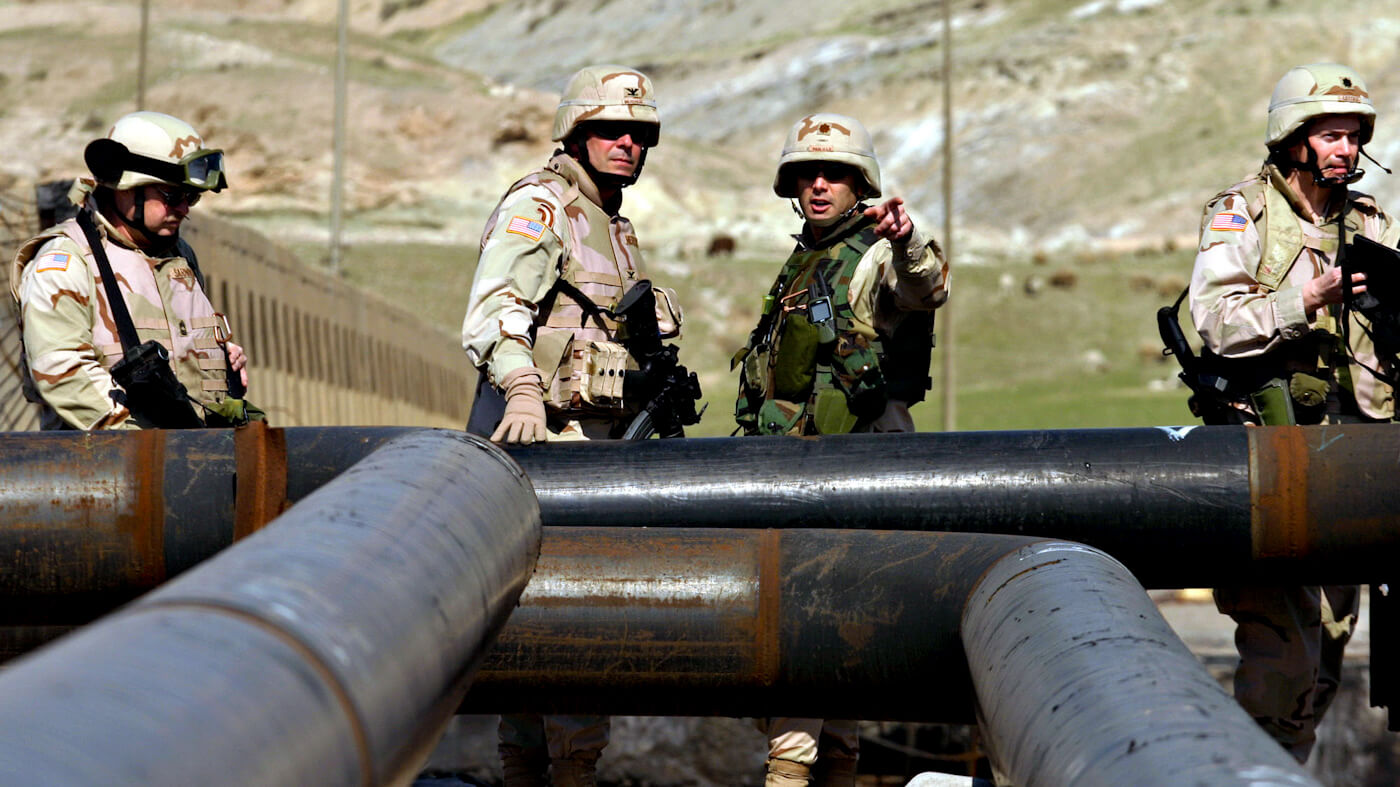
U.S. Army Col. Gordon Mereness is briefed on oil pipeline expansion possibilities near Bayji, Iraq, March 20, 2005. Sasa Kralj | AP
Libya also had plans to undermine the dollar’s grip over the global oil trade. An email from Hillary Clinton advisor and ally Sidney Blumenthal, which was scrubbed from the State Department’s website, revealed that French intelligence had discovered Libya’s vast gold and silver reserves and feared they would be used to back a pan-African currency, the Dinar, to rival the French franc, the Euro, and the dollar. The email goes on to casually describe France’s motivations for intervening — oil, unsurprisingly, topping the list:
- A desire to gain a greater share of Libya oil production
- Increase French influence in North Africa
- Improve his internal political situation in France
- Provide the French military with an opportunity to reassert its position in the world
- Address the concern of his advisors over Qaddafi’s long term plans to supplant France as the dominant power in Francophone Africa
While the initial efforts to destroy Libya were spearheaded by France and Britain, none of these goals were in any way objectionable or contrary to U.S. foreign policy objectives and the interest of maintaining the petrodollar system, which is why the U.S. quickly became a leader in the assassination campaign. Despite mass pro-government protests of over a million people against the NATO intervention, which went nearly unreported in the corporate media, in the following months, Libyan leader Muammar Gaddafi was beaten to death by NATO-armed rebels in the streets of Tripoli.
Part of the reason the United States continues to maintain such a heavy military presence in Bahrain, Iraq, Kuwait, Oman, Qatar, Saudi Arabia, United Arab Emirates, Egypt, Israel, Jordan, Yemen, Syria, and so on is that U.S. bases in these countries serve as launching pads for invasion against the next oil-bearing country that tries to defy the global financial order. Where oil is buried, in a way, the U.S. must go in order to ensure the petrodollar system is preserved. Oil quite literally guides U.S. foreign policy. However, more and more people are seeing America’s financial trickery for what it is and America can force the world to comply only for so long.
Creating a new global financial system
Today, two OPEC countries are trying to shake loose the petrodollar system: Venezuela and Iran.
Contrary to what we’ve been taught to believe, they don’t do these things because they “hate America” or “hate freedom” but because they’re forced to. Both countries have faced decades of slander and, in recent years, outright economic warfare in the form of restrictive financial sanctions that limit their access to international markets. As mentioned in the beginning of the article, these sanctions are designed to limit Venezuela and Iran’s ability to acquire foreign reserves, and by extension, import things like medicine.
This isn’t even a secret — it’s an openly stated goal of the sanctions policy. Donald Trump’s lawyer, Rudy Giuliani celebrated the success of the sanctions after reports stated Iranians were selling their organs and begging for food. In a particularly genocidal episode, Mike Pompeo said that the Iranian leadership would have to “make a decision that they want their people to eat,”meaning install a U.S.-aligned government or continue to starve under the sanctions regime.
Faced with no good options, both countries have been experimenting with more creative ways of transacting with international trade partners. Most obviously, both countries have dropped the dollar from their international exchanges, pricing goods in other reserve currencies like Euros and Yuan. This means you cannot import goods from these countries with dollars.
Furthermore, both countries are trying to repopularize gold as a means of international payment. As sanctions crashed the value of the Iranian rial, demand for gold in Iran hit four-year highs. Iran is relying more heavily on its gold reserves to conduct trade. Iran is exploring exporting oil products to various African nations in exchange for gold. Iran has made similar agreements with India and Turkey.
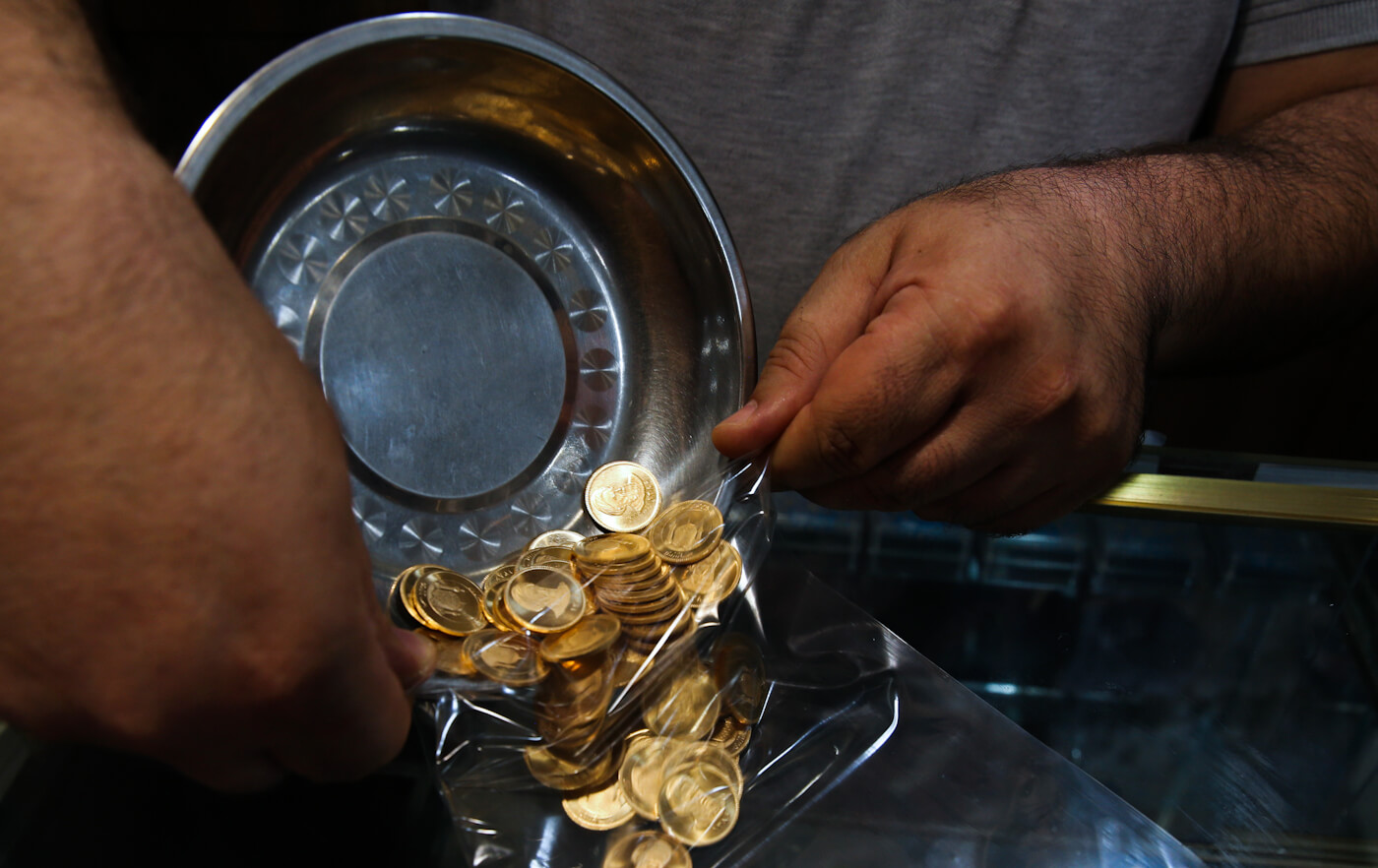
An Iranian goldsmith counts gold coins in the sprawling Grand Bazaar, that has seen customers eagerly buying gold as a hedge against U.S. sanctions. Vahid Salemi | AP
Similarly, Venezuela is attempting to use its gold to acquire foreign reserves. Venezuela recently tried to withdraw $1.2 billion worth of its own gold stored in the vaults of the Bank of England, only to be denied. In response to Caracas’ attempts to subvert financial sanctions, Venezuela’s enemies — namely the Lima Group, a U.S. sponsored organization of Latin American countries — have insisted that Venezuela should be prevented from using oil and gold to conduct international trade. The U.S. has already imposed sanctions on Venezuela’s gold mining industry, which prevent American individuals and companies from buying Venezuelan gold.
Finally, both countries have created gold-backed cryptocurrencies, which will be used as alternatives to the dollar as means of payment. Venezuela’s crypto, Petro, is backed by Venezuela’s natural resource wealth: gold, diamonds, oil, iron and so on. Western pundits wasted no time warning people on the internet that Petro was a bad investment — the only problem being that Petro wasn’t created as a vehicle for money-making as most Western cryptos are.
Petro was created solely for the purpose of being a currency for Venezuelans to send to other countries to buy goods they could not buy under the sanctions regime. With oil and gold backing, Petro’s value is largely decided by the global oil and gold prices; you won’t make a lot of money speculating on the value of Petro. Iran recently unveiled its own gold-backed cryptocurrency, the PayMon, weeks ago. Similar to Petro, PayMon gives Iran the ability to get around U.S. financial sanctions.
Iran and Venezuela’s maneuvers have raised eyebrows but in the context of the larger global trend of de-dollarization, they pose a much greater threat than as individual occurrences. Much larger economies are also moving to end their dependence on the dollar and are seriously considering creating multilateral trading blocks free of the dollar.
After Washington tightened sanctions on Russia regarding Russia’s activities in Crimea, Russian President Vladimir Putin said that Russia would work towards completely dumping the dollar. So far, Russia has made good on this promise, dumping 84 percent of its U.S. debt holdings and massively increasing its gold reserves in the last two years. As Russian Foreign Minister Sergey Lavrov once stated:
Washington immediately stops servicing any banking operations in dollars in relation to both the country that they want to punish and also all those who have some kind of relationship with it.”
China and Japan, America’s biggest foreign-debt holders, have also been shedding U.S. debt holdings, albeit at a steady pace. Turkey and India have also lowered their U.S. bond holdings by similar amounts in recent months. Each country in the Shanghai Cooperation Organization has eliminated the use of the dollar in trade with at least one other country in the organization. It’s hardly inconceivable that eventually these countries will conduct deeper, more robust trade within the organization without the dollar. Even the EU is considering asserting the Euro’s role on the international stage. Last year, China, What do all of these actions amount to? As discussed earlier, at its root, money has power because people believe it does. Each of these small changes reduces the belief in the dollar’s hegemony just a little bit. Eventually, in theory, these small material changes will lead to a larger qualitative change in the world financial system.
This type of massive change will not happen overnight but the world financial system may encounter a series of unrectifiable challenges in the next decade. But, of course, as any empire would, the U.S. will not simply allow the world to trigger a second Triffin Dilemma while it sits silently and watches; it will fight to maintain the status quo that made it an empire.
Subscribe to:
Posts (Atom)