Tuesday, February 25, 2014

Monday, February 24, 2014

Wednesday, February 19, 2014

Saturday, February 15, 2014
The Complete History of Israel's Intelligence Community: Mossad, Aman, and Shin Bet (1990)


NOW YOU UNDERSTAND WHY THIS IS HAPPENING NOW
Friday, February 14, 2014

Monday, February 10, 2014


Wednesday, February 5, 2014
The Destruction of Africa: Travel, History, Politics, Economics, Foreign Aid, and Religion (1990)

Today, Africa contains 54 sovereign countries, most of which have borders that were drawn during the era of European colonialism. Since colonialism, African states have frequently been hampered by instability, corruption, violence, and authoritarianism. The vast majority of African states are republics that operate under some form of the presidential system of rule. However, few of them have been able to sustain democratic governments on a permanent basis, and many have instead cycled through a series of coups, producing military dictatorships.
Great instability was mainly the result of marginalization of ethnic groups, and graft under these leaders. For political gain, many leaders fanned ethnic conflicts, some of which had been exacerbated, or even created, by colonial rule. In many countries, the military was perceived as being the only group that could effectively maintain order, and it ruled many nations in Africa during the 1970s and early 1980s. During the period from the early 1960s to the late 1980s, Africa had more than 70 coups and 13 presidential assassinations. Border and territorial disputes were also common, with the European-imposed borders of many nations being widely contested through armed conflicts.
Cold War conflicts between the United States and the Soviet Union, as well as the policies of the International Monetary Fund, also played a role in instability. When a country became independent for the first time, it was often expected to align with one of the two superpowers. Many countries in Northern Africa received Soviet military aid, while many in Central and Southern Africa were supported by the United States, France or both. The 1970s saw an escalation, as newly independent Angola and Mozambique aligned themselves with the Soviet Union, and the West and South Africa sought to contain Soviet influence by funding insurgency movements. There was a major famine in Ethiopia, when hundreds of thousands of people starved. Some claimed that Marxist/Soviet policies made the situation worse. The most devastating military conflict in modern independent Africa has been the Second Congo War; this conflict and its aftermath has killed an estimated 5.5 million people. Since 2003 there has been an ongoing conflict in Darfur which has become a humanitarian disaster. Another notable tragic event is the 1994 Rwandan Genocide in which an estimated 800 000 people were murdered. AIDS in post-colonial Africa has also been a prevalent issue.
In the 21st century, however, the number of armed conflicts in Africa has steadily declined. For instance, the civil war in Angola came to an end in 2002 after nearly 30 years. This has coincided with many countries abandoning communist style command economies and opening up for market reforms. The improved stability and economic reforms have led to a great increase in foreign investment into many African nations, mainly from China, which has spurred quick economic growth in many countries, seemingly ending decades of stagnation and decline. Several African economies are among the world's fasted growing as of 2011. A significant part of this growth can also be attributed to the facilitated diffusion of information technologies and specifically the mobile telephone.
IMPORTANT: Americans May Be Locked Up in FEMA Concentration Camps Admits Supreme Court Justice Antonin Scalia
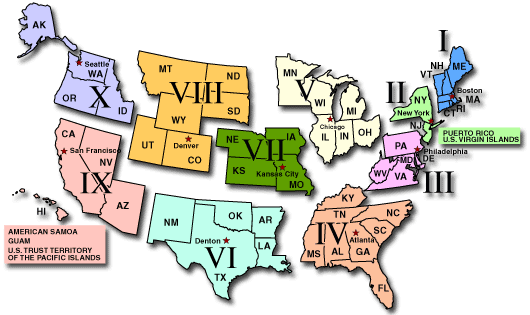
FEMA REGIONS

IMPORTANT RED ALERT
Source: http://washingtonexaminer.com/justice...
Leaked Document Military Internment Camps in U.S
The Terrifying Future of The United States
U.S. Government Preparing for Collapse (and Not in a Nice Way)
Jesse Ventura Police State FEMA Camps Full Episode
Jericho - Crossroads Ep- Life after a False Flag Attack

Friday, January 31, 2014

'American Anthrax' Exposes Attacks as Inside Job

Media Roots presents American Anthrax, a documentary comprised of news footage that establishes, by history's own narration, how everything you've been told about the Anthrax Attacks is a lie. Conceptualized, edited and produced by Robbie Martin, co-host of Media Roots Radio.
September 11, 2001, shook the United States to the core, a country that had been nearly untouchable since its democratic inception. However, immediately following this horrific tragedy, another equally as impactful 'terrorist attack' occurred when weaponized anthrax was sent to multiple Congressman and journalists through the U.S. Postal Service.
The attacks on the World Trade Center and the Pentagon were both one-time events that happened in two prominent cities. Unlike 9/11, the Anthrax Attacks localized terrorism and spread fear to every corner of American life, where the simple act of getting your mail could prove to be fatal. Five people died as a result of breathing in the deadly anthrax spores, including postal workers and one NY Post reporter. Countless others were infected.
The Bush administration initially tried to link this 'second wave of terrorism' to al-Qaeda with zero proof. Once that talking point out-lived its usefulness, the official narrative began leaning towards Saddam Hussein and his mythological biological weapons program.
Establishment propagandists like John Mccaine and ABC news reporters intentionally spread disinformation to plant the seed in the public mind that the anthrax came from Iraq, which eventually lead to Colin Powell's infamous 2003 WMD speech at the UN. All the while, the U.S. government was fully aware that the anthrax did not come from an external source, because the strain showed tell-tale signs of being a specific anthrax strain that was weaponized and manufactured by the U.S. military.
Regardless, the idea of the Anthrax Attacks being executed by an external terrorist organization remained conventional wisdom the public was conditioned into believing in the aftermath of 9/11. Eventually, two men were accused of being the perpetrators behind the attacks, yet no charges were ever brought to either of them. The first accused individual, Steven Hatfill, ended up being rewarded a multimillion dollar settlement from the government for being wrongly accused before any evidence was presented against him. The subsequent accused individual, Bruce Ivins, allegedly committed suicide while the FBI was trying to break him into confessing.
Ultimately, the FBI asked the National Academy of Sciences (NAS) to verify its evidence pointing to Ivins as the main suspect. Instead, the NAS concluded that the DNA in the anthrax sent in the mail was in fact not a match to the anthrax Ivins worked with. Before the National Academy of Sciences finished their independent investigation, the FBI rushed its preestablished conclusions about Ivins's guilt to the press, and the case was closed. To this day, the FBI has never commented on the many glaring contradictions in the official government narrative about the Anthrax Attacks.
Follow Robbie at @fluorescentgrey
Subscribe to:
Posts (Atom)